
A sliding patio door is usually the weakest door in the house, and not because of the glass. The trouble is the hardware: a small hook latch that grabs a keeper on the frame, and a heavy panel that rides on rollers in a track. If the panel can be raised enough to clear that hook, or if the hook barely reaches the keeper, the door opens without a sound. The fixes are not complicated, but you need to know which problem your door has before you buy anything.
A lot of houses in Chelmsford are ranches and split-levels from the decades after World War II, and many have a slider off the kitchen or the lower-level family room that opens to a back deck or patio. On a split-level, that lower door often faces the backyard and sits out of view from the street, which is exactly why it deserves a closer look.
Three checks you can do yourself tonight
You do not need tools for these. Do them with the door closed and latched.
- The lift test. Grip the handle of the moving panel and push straight up as hard as you can. Look at the gap at the top. If the panel rises noticeably, there is too much room in the upper track, and that space is what a burglar uses to lift the door off the latch.
- The rattle test. With the latch locked, pull and push the panel sideways. A good latch holds it firmly. If the panel moves a quarter inch or more before stopping, the hook is only catching the edge of the keeper.
- The look test. Open the door and look at the latch on the edge of the panel. Turn the lock lever and watch the hook come out. Then look at the keeper on the jamb. Shiny wear marks low on the keeper, or a bent hook, mean the two are not lined up anymore.
Many homeowners fail the second test and assume the lock is broken. Often it is not. The panel has sagged on worn or out-of-adjustment rollers, so the hook now meets the keeper too low. Adjusting the rollers can bring it back into line before anything gets replaced.
Which fix for which problem
Here is how we match the hardware to what the checks turned up.
| What you found | What usually fixes it |
|---|---|
| Panel lifts at the top | Anti-lift blocks or screws set into the upper track above the moving panel, adjusted so the door still slides but cannot be raised |
| Latch rattles or barely catches | Raise the rollers with the adjustment screws at the bottom of the panel, then reset or replace the keeper |
| Hook is bent, worn or the lever is loose | Replace the mortise latch and handle set with one sized for your door |
| No way to lock it from outside | A handle set with a key cylinder, or a separate keyed patio lock |
| You want a second lock that is not the latch | A foot lock at the bottom of the panel, or a hinged bar across the opening |
One caution about replacement latches: sliders from different makers use different screw spacing, hook shapes and backset. A latch that "almost fits" tends to catch the keeper badly, which puts you right back at the rattle test. Measure the old one, or have us bring a few options to match it.
The dowel in the track: still worth it?
A cut-down broomstick or a metal bar lying in the bottom track is the oldest trick there is, and it does stop the panel from sliding. It does nothing against lifting, though. Use it as a backup, not as the main lock. If you have kids or older family members using the door, a hinged bar that folds down from the frame is easier to live with than a loose stick that ends up behind the couch.
In winter there is one more thing to watch. Snow and slush tracked onto the deck can freeze in the bottom track, and people force the handle to open a frozen door. That bends the latch hook over time. Keep the track clear, and if the door is binding, look at the track before you blame the lock.
If your patio door is a hinged French door instead
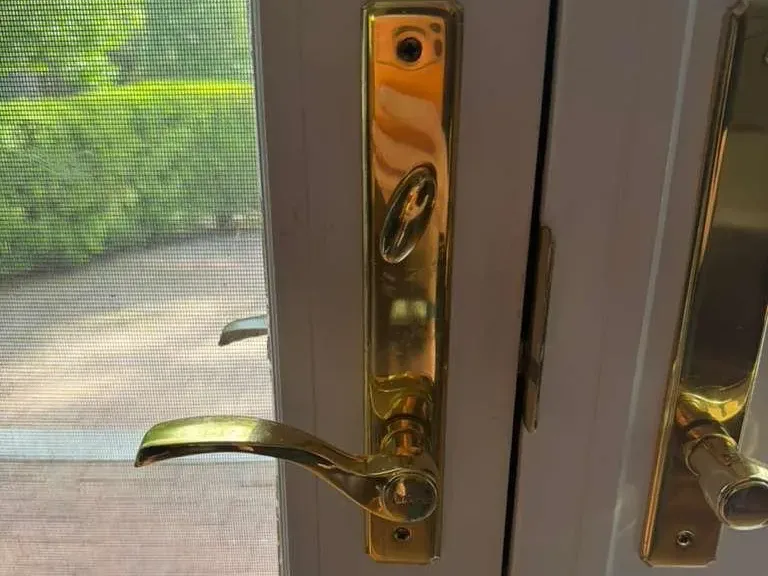
Not every back door slides. The photo with this post shows the inside of a hinged French patio door we worked on: a long brass plate with a lever and a thumb-turn above it, and a screen door on the outside. Doors like this usually have a multipoint lock, which means one turn throws bolts or hooks at more than one spot along the edge of the door. When a French door gets hard to lock, the cause is often the same as with a slider: the door has dropped a little, the bolts no longer meet their keepers, and someone starts forcing the handle. Adjusting the hinges and keepers comes first. Forcing it is how gearboxes inside these locks break.
The second panel on a pair of French doors also matters. Check that its top and bottom bolts actually go into the frame and the floor. If those bolts are left up, the whole pair can be pushed open from outside even with the main lock set.
What we do on a patio door visit
When we come out, we run the same checks you just did and then look at the parts you cannot see: roller condition, the screws holding the keeper (short screws into soft trim pull out easily), and the head track. We tell you what we found and what each fix involves, and you get the full cost before we touch the door. Sometimes the answer is a roller adjustment and two anti-lift screws. Sometimes the latch and handle need to go.
While we are there, it often makes sense to rekey the front and side doors to match, especially if you just bought the house. If you are thinking about a keypad on the main entry, our post on smart locks in New England weather covers what to expect.
See our sliding door and patio lock service, or our North Chelmsford locksmith page for the area we cover around Chelmsford.
Can a locksmith add a key lock to a sliding door?
Yes. Many sliders can take a handle set with an outside key cylinder. Where the door frame or panel does not allow it, a separate keyed patio lock mounted on the panel is another option. We check the door's profile before we suggest one.
My slider is hard to open and close. Is that a lock problem?
Usually not. A door that drags is most often worn or low rollers, a dirty or damaged bottom track, or ice in the track. Fixing that also tends to make the latch work properly again.
Are anti-lift blocks hard to install?
They are small pieces set in the head track above the moving panel. The trick is setting the clearance so the door cannot be lifted off but still slides freely and can be removed later for service.