
Every winter the same call comes in from business owners: the back exit closes, but it does not latch. Someone finds it standing a half inch open the next morning, or the alarm company reports it unsecured overnight. In most cases the panic bar itself is not broken. Cold weather changes the way the door, the closer and the building behave, and the latch is simply not getting all the way into the strike.
Lowell has a lot of the kinds of buildings where this shows up: old brick mill buildings turned into offices, studios and apartments, with long stairwells and heavy steel doors, and downtown storefronts with exits onto alleys and back lots. Below is the order we check things in when we arrive, so you know what is going on and what you can safely look at yourself.
Step 1: Watch the door close on its own
Open the door fully, let go and watch. Do not help it. You are looking for one of three things:
- It slows down and stops short. That points to the closer. Most closers are hydraulic, and the fluid gets thicker in the cold, so a closer set in July can be too slow in January.
- It reaches the frame and bounces back. The latch is hitting the strike and not dropping in. That is alignment.
- It hangs open an inch and floats there. Air is pushing against it. That is building pressure, covered in step 3.
This one minute of watching tells us more than anything else, and you can do it yourself before you call.
Step 2: The closer
A door closer has adjustment valves that control the speed of the door swing and how hard it finishes the last few inches, which is called latch speed. When a closer slows down in the cold, we adjust those valves so the door finishes with enough force to push the latch home, without slamming. Many closers sold for exterior doors use fluid meant to stay steady across temperatures, but older or interior-grade closers on outside doors are common, and those drift the most.
A few signs mean the closer is done and adjusting will not help: oil on the closer body or the floor under it, an arm that moves with no resistance, or a door that slams no matter how the valves are set. Then the closer gets replaced. Our door closer service page has more on that.
Please do not unhook the closer arm or prop the door to "let it settle." An exit door has to close and latch by itself.
Step 3: Pressure in the building
When it is cold outside and warm inside, warm air rises through a building and pushes out near the top while cold air pulls in near the bottom. Engineers call this the stack effect. In a multi-story building, such as a mill with an open stairwell, it can be strong enough to hold a ground-floor exit door slightly open, or make an upper door hard to push. Kitchen exhaust fans in restaurants do something similar by pulling air out of the space.
Making the closer stronger is the obvious answer, but there is a limit. An exit door still has to open without too much force for anyone who needs to get out. We balance closer power against that, and sometimes the better fix is with the building, like a stairwell door that should not be propped or a makeup-air problem that a mechanical contractor needs to look at. We will tell you which side the problem is on.
Step 4: Strike, latch and rods
Steel doors and frames move with temperature, and buildings settle. A rim strike that lined up perfectly in the fall can be off by a small amount in the cold, and that is enough for the latch to hit the edge of the strike instead of dropping in. We check:
- Whether the latch bolt projects fully and springs back crisply when you release the bar
- Scrape marks on the strike that show where the latch is actually landing
- Loose strike or device screws, which are common on doors that get slammed a lot
- The hinges, since a sagging door drops the latch below the strike
Pairs of doors with vertical rod devices get extra attention in winter. The bottom latch goes into a strike in the floor or threshold, and that is where snow, ice, sand and salt collect. A packed or frozen floor strike stops the bottom rod from latching, and if someone forces the door, the rod bends. Keeping that strike clear helps a lot. For doors that keep failing at the floor, there are devices that latch only at the top, which we can talk through with you.
About the device in the photo
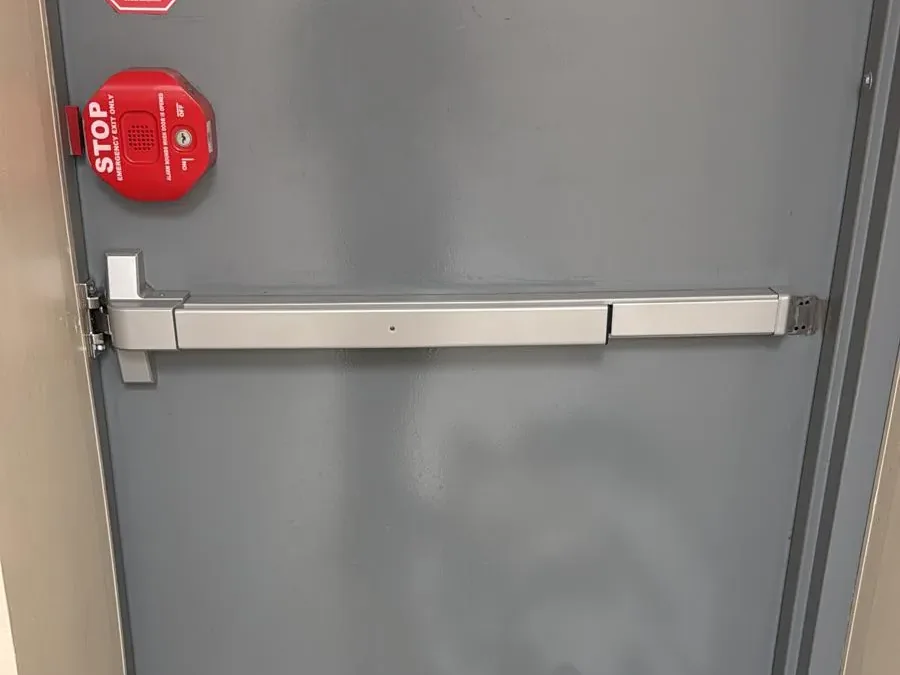
The photo with this post is one of our jobs: a gray steel exit door with a rim-type panic bar, the most common setup on single exit doors, and a separate red battery alarm above it with a key switch, so staff can arm it and the door sounds if someone pushes out. A rim device like this latches to one strike on the frame, which makes alignment easy to check: if the latch is not catching, the answer is almost always at that strike, the hinges or the closer. A separate alarm also means two things to look at when the door acts up, so we test the alarm along with the latch once the door is adjusted.
What not to do with an exit that won't latch
We understand the pressure to lock the place up for the night. Still:
- Never chain, padlock or bar an exit door. If people are inside, it has to open with one push.
- Do not leave a panic device dogged (held in the unlatched position) overnight to "get around" the problem. That leaves the door unlocked.
- If the door is a fire-rated door, the hardware on it is fire exit hardware, and that type is not allowed to have mechanical dogging. Do not add it.
- If you are not sure what your building is required to have on a door, check with the Lowell Fire Department or the city's building department.
When we finish, we cycle the door repeatedly to make sure it closes and latches every time, not just once. Before any work begins, we go over what we found and what it will cost. For more on the devices themselves, see our panic bar and exit device page, and for the city, our Lowell locksmith page. If an exit problem also has you thinking about who holds keys to the building, our post on key control when an employee leaves may help.
Why did our exit door work fine all summer and stop latching now?
Cold thickens closer fluid, changes the air pressure inside the building and makes steel doors and frames move slightly. Any one of those can keep the latch from reaching the strike. Usually a closer adjustment and strike alignment take care of it.
Can you just make the closer stronger?
Up to a point. A stronger closer helps against air pressure, but an exit still needs to be easy enough to open for anyone inside. We set it to latch reliably without making the door hard to push.
Is it the panic bar or the door?
Push the bar and release it with the door open. If the latch moves in and out smoothly, the device is likely fine and the problem is the closer, the strike or the door hanging. If the latch sticks or the bar feels loose, the device needs repair.