
When a key snaps, the half in your hand tells you very little. What matters is the half still inside: how far it sticks out, which way it is pointing, and whether the door is locked or open. Those three things decide whether you can fix this yourself in a minute or whether any more fiddling will turn a small job into a new lock. The short answer: one gentle, straight pull with pliers is fine if you can grab the piece. Glue, hairpins and repeated twisting are not.
Read the situation before you touch anything
Look into the keyway with your phone's flashlight. Then find your situation in this table.
| What you see | What to do |
|---|---|
| Blade sticks out a few millimeters, key is upright (the way you put it in) | Grip it with needle-nose pliers and pull straight out, no wiggling up or down. One or two tries, then stop. |
| Piece is flush with the face of the lock, key upright | Do not push anything into the keyway. Call a locksmith; this is usually a short extraction. |
| Key broke while turned sideways | Do not try to pull it. The pins are holding it. The plug has to be turned back to its upright position first, which takes the right tool. |
| Door is open and the bolt is retracted | No emergency. Leave the door unlocked or use another door, and book a visit at a time that suits you. |
| Door is locked and you are outside | This is a lockout plus an extraction. Call us; we handle both in one visit. See emergency lockout service. |
| You already tried glue | Stop and tell the locksmith. The cylinder will likely need to be replaced, not just cleared. |
Why turned-sideways breaks are different
A pin tumbler lock has small spring-loaded pins that sit in the cuts of your key. When the key is upright, in what locksmiths call the home position, those pins drop back into their holes in the cylinder housing, and a broken piece can slide out. Once the key has been turned even partway, the plug is out of line with those holes. The pins press down on the key and hold it. Pulling hard at that point bends the piece, chews up the pins, or leaves the plug stuck between positions.
That is why we carry tools that do more than grab. A thin plug spinner or a tension tool turns the plug back to upright first, and only then do we draw the piece out with an extractor. On a deadbolt that broke partway through its throw, the bolt may also be half-extended, so we check the bolt and the strike plate before we call the job finished.
Things that make it worse
Most of the broken-key jobs that end with a new cylinder started as simple ones. The usual culprits:
- Superglue on the broken half. The idea is to glue the two halves together and pull. In practice the glue runs into the keyway and bonds to the pins and plug. Then the cylinder has to be drilled or replaced.
- Bobby pins and paper clips. They are softer than the brass key and tend to push the piece deeper, or break off themselves. Now there are two pieces in the lock.
- Using the other half as a tool. Pushing the head of the key back in to "turn it the rest of the way" can bend the blade inside the lock and wedge it.
- Spraying oil into the keyway. A heavy oil can help a stuck key slide out, but it leaves a film that collects dust. Graphite or a lock lubricant made for cylinders is the better choice afterward, not a household oil.
- Heating a frozen lock with a lighter. On a cold Chelmsford morning it is tempting. An open flame near a painted or vinyl door, or a plastic smart lock housing, is a bad trade. A hair dryer on a cord does the same job.
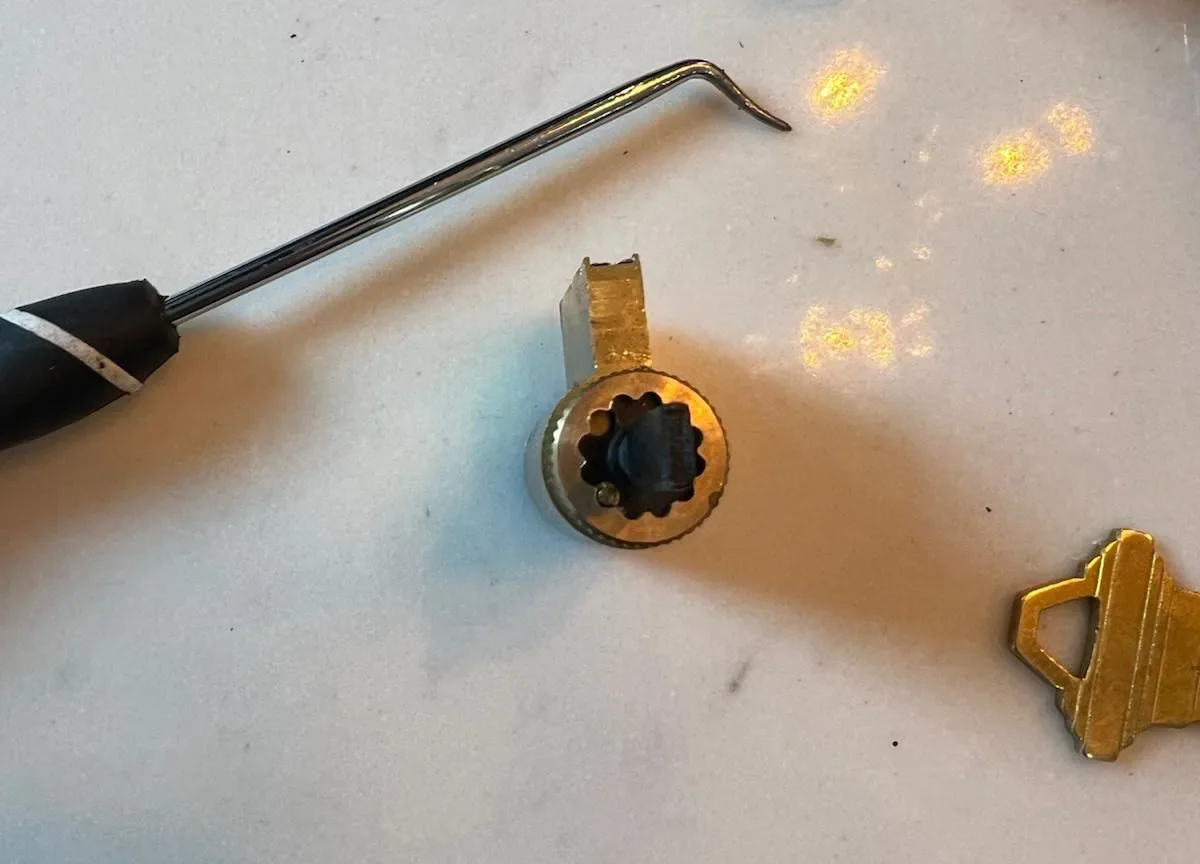
What the photo above shows
The image at the top of this post is from our bench. The brass piece in the middle is the plug of a lock cylinder: the part that turns when the key is in. It has been slid out of its housing. The gold tab on top is the cam that drives the bolt or latch. Beside it is a hook pick, one of the small tools we use to lift a stubborn piece of blade out of a keyway.
When an extractor alone will not free a broken piece, this is the next step. We take the cylinder out of the door, push the plug out of its housing with a follower tool so the pins stay in order, and clear the keyway on the bench in the van. Then everything goes back together, and the lock works with a new key. The same open plug is also how we inspect pin damage after a rough extraction.
Why it happened, and how to stop it happening again
Keys rarely break for no reason. When we are done at the door we look for the cause, because a new key in the same stiff lock will crack too, just later.
- Check the key itself. Look at the shoulder of your other keys for that lock. A hairline crack or a thinned neck means it is next.
- Feel how the lock turns. If you have to lean on the key, the lock needs cleaning or lubrication, or the cylinder is worn out.
- Watch the bolt. If the key gets hard only when the door is closed, the bolt is rubbing on the strike plate. In New England, wooden doors and frames swell and shift between seasons, and a strike that lined up in August can drag in February. Moving or filing the strike fixes the real problem.
- Retire copies of copies. A duplicate cut from a worn key passes the wear along. We cut new keys to the lock's code or by reading the lock, not by copying the broken halves.
Many Chelmsford homes are ranches, capes and split-levels from the decades after the war, and plenty still have their original or second-generation entry hardware. Brass cylinders that have seen fifty winters are often worn enough that a repin or a new lock makes more sense than a fresh key. We will tell you which, and what each costs, before we touch anything. See our lock replacement page for what that involves.
Getting help in Chelmsford and nearby
We are a mobile locksmith based in North Chelmsford, so the van comes to you with extractors, a key machine and spare cylinders. Our broken key extraction page covers the service in short form, and our North Chelmsford locksmith page covers the area we work in. If the problem is a lock that is frozen rather than broken, our post on being locked out on a cold night has the steps for staying warm while you wait. We are open 24/7.
Can I still lock the door with a broken piece inside?
Usually not. The piece blocks the keyway, so no key can enter. If the door is unlocked and you need it secured tonight, use a second door or a chain until the lock is cleared.
Will I need a new lock?
Most of the time, no. If the piece comes out cleanly and the pins are fine, a new key is all you need. If glue was used or the pins were damaged, we repin or replace the cylinder.
Can you make a key from the two broken halves?
We can read them, but we prefer to cut from the lock itself, because the broken key was probably worn. A key cut to the lock's original depths turns more smoothly and lasts longer.